
We just finished up a truly off-grid solar system, which despite what most people think is pretty rare in the solar world. When most people think of off-grid solar, they don’t actually realize what off-grid means. Off-grid solar is by definition, a solar array and system that can function completely without the grid. On the other hand, even if people do understand this meaning, they don’t realize how difficult and expensive it is to make a fully off-grid solar system. That’s why it’s so rare.
Most People Don’t Need an Off-Grid System
There are however many people who are looking for a completely off-grid solar system and I’ll explain the different times it makes sense to build an off-grid solar array. Most people are just trying to offset their power bills. For this, it’s best to go with a gird-tie solar system. Going grid-tie will always be the most inexpensive option. For the time being, you can still sell power back to the utility company and they will credit your account. This won’t always be an option though, because power companies are lowering the amount they will pay you for the power you generate. A grid-tie solar array is simply a solar setup that requires a connection to the grid to properly function. Grid-tie systems do not usually allow you to use the power generated if there is a power outage.
When it Makes Sense to Design an Off-Grid Solar System
There are a couple of different times when off-grid solar starts to make a lot of sense. Some people use off-grid solar when they are designing some sort of cabin or retreat that is in the woods and grid power is simply not an option. Sometimes the cost to get grid power out to a location exceeds the amount it would cost to simply design an off-grid solar system. The second reason people tend to build off-grid solar systems is when they are preparing for disaster. People have a lot of different reasons for not wanting to be attached to the power grid. Overall, “Off-grid” is for people that don’t generally have a desire to be on the grid.
An Off-Grid Cabin
Maybe you’ve always dreamed of building some sort of cabin in the woods that you can visit to clear your head. In fact, as I’m writing this, that sounds like a good idea for me. Sometimes you need to be disconnected from life completely, but you don’t necessarily want to go sleep in a tent. This is when you would build an off-grid cabin. In the past decade, vacation rentals have become increasingly popular. Imagine making an off-grid vacation rental that you can use when you need it, and you can rent it out when you don’t. Now that’s an idea!
Many hunters like to camp out in the boonies while they plan their next move on their prey. Imagine if instead of camping out somewhere, you had a sweet cabin you could sleep in and live pretty normally but still disconnected enough that you can decompress your mind. That sounds pretty great to me.
Overall the investment amount would be greater than that of a grid-tie home. There’s no question about that. However you would also save money on things like permits, and you probably wouldn’t even need as much power generation as that of a tractional home. Most off-grid solar systems start at $50k or more, for a traditional home with all of its comforts. However, if you just need hot water, air conditioning and run small appliances, you could get by with a system under $20k, easily.
Another kind of Off-Grid Cabin (Emergency Preparedness)
Another reason people want to design an off-grid solar system as opposed to a grid-tie solar system is for emergency preparedness. You may not consider yourself a prepper, but some areas of the world lose power regularly and making your own power is very wise. There are also many tornado prone areas and earthquake prone areas where this makes a lot of sense. Sometimes these types of homes can opt for a “hybrid” solar system. We will talk about that a little bit later.
However, building a home that you can escape to in the event of a meltdown is another reason people consider off-grid solar. You may not feel like you need a survival bunker in middle of nowhere, but maybe you would like an off-grid cabin. In fact, I’m convinced that many of these off-grid bunkers are just man-caves disguised as a emergency preparedness location.
Less Developed Countries (humanitarian)
Many of us don’t realize just how undeveloped other countries can be. In fact, you can’t fully understand it until you visit them. Some of us have seen extreme poverty firsthand. In these lesser developed countries, instead of waiting around for a power company to visit an area that needs power, citizen who care an awful lot about others can take matters into their own hands. People can make their own miniature power plants that bring power to entire communities. And since these people aren’t exactly used to air conditioning all the time, they don’t need much power at all.
We’ve had multiple requests from people in countries like Haiti that desperately want to make their own power. Maybe you’re reading this because you’re in a country like that. This article is not meant to cast judgement on your country for being less developed in the power sector. This also ties back to the emergency preparedness reason stated previously because a lot of times power could be available but it’s on and off all the time.
How to Design an Off-Grid Solar System
Maybe you want to design an off-grid solar system for one of the reasons mentioned above. Or, you could be designing an off-grid solar system for a completely different reason. Let us know below in the comments if you have another reason for building an off-grid solar array. But you’ll have to make sure you go about building it in the right way. Because, just like with any other solar power project, making the wrong decisions early on, results in more money spent. You would probably like to save money, right?
Calculate your Power Requirements
So first, you’ll need to calculate your power requirements. Your power requirements are pretty easy to figure out with a home that is connected to the grid because you can just read your power bill. Your power bill will detail exactly how many kilowatt hours, you are using. This is abbreviated as kWh, typically. I’ll go into more detail about that in a minute. However, what if you’re building a new off-grid cabin or home?
If you’re starting from scratch, it’s a little bit more complicated to calculate your power consumption, but it’s also much more fun. Since you’re starting from scratch, you can select all of the components and appliances based on what is the most efficient. Normally, we don’t really read our refrigerator’s efficiency or power consumption description. However, when using a more efficient fridge can result in thousands of dollars saved in purchasing the solar equipment, it makes a lot of sense to figure that out.
So, just make a list of everything you know of that will be in the cabin/home that uses electricity. This includes lighting, air conditioning, and refrigeration. Once you write down what you need, you can start recording the estimated kWh’s required per day for each appliance. This will help you build the correct size solar array and allow you to get the right size inverter and batteries. For example, if you just wanted to run a fridge, some lights and charge your phone, you might only need 5 kilowatt hours in one 24 hour period. That means that no matter what, if you want to have power and not run out, you’ll have to produce 5 kilowatt hours per 24 hr period. It is also pretty common to produce more than you need, just to be safe.
[chart] (The average fridge uses 4 kWh per day, lights use 1kWh and charging your phone is like nothing)
Calculate your Sun-Hours and Panel Requirements
So for this “mini” off-grid cabin, let’s figure out how many panels we need to produce 5 kWh per day. First of all, we need to calculate the sun hours. Sun hours simply means, how many hours per day you can actually generate solar power. For example, you’re not going to have as many sun hours in Minnesota as that of Arizona. For this example, we’ll go with an average sun-hour amount from most states in the USA. You can find your sun hours using this map. There are also many other solar insolation maps for other countries in the world.
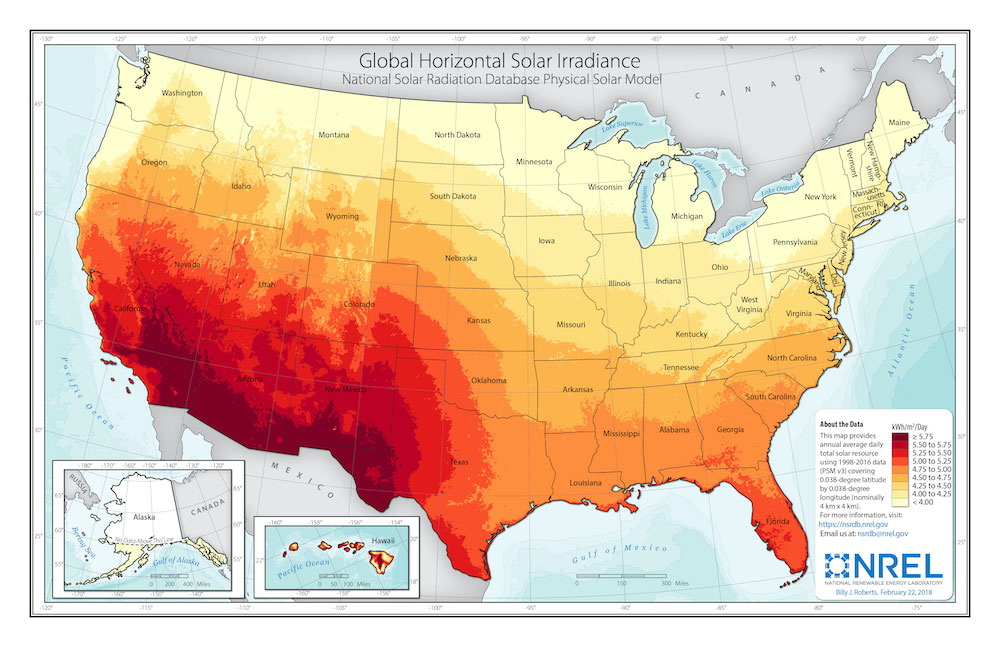
So our sun hours are 4.5 useful hours of solar energy. Keep in mind that you will, in fact, need a place on the roof or near the cabin on the ground that is clear and free of hard shadows from trees. Solar panels work well despite “soft-shadows”, but completely stop producing efficiently when there are “hard shadows” from things like trees. I thought I should mention this since it’s very likely that this project will be in the woods. In the woods, there’s not a lot of open space, so you may have to clear a small area.
Once you know your sun-hours you can calculate how many panels you need. In this case, since we just want to generate around 5 kWh (7 to be safe), we will need to make sure our solar array size is large enough to produce this. To figure out your daily solar production just multiply the solar array size by the amount of sun hours. In this case, we’ll divide since we don’t know the array size we need yet.
[equation] sun hours*solar panel output = solar production or divide production by the sun hours to find the panel output needed.
So let’s divide our desired production by the amount of sun-hours we get. 7 kWh/4.5 = 1.5 kW. 1.5 kW is a very small solar array. 1.5 kW can be simplified as 1500 watts of solar. That’s the amount of solar you would need for something like an RV. But, since this is just a simple demonstration for our mini off-grid cabin, it will work. Now we can figure out exactly how many panels we need. Since panels don’t really come in single digit amounts, you may have to round up according to the number you calculate. In our case, we’ll need 5 300 watt solar panels. Solar panels usually come as 300 watt panels, but they are slowly increasing capacity and efficiency. Try to find panels that are a reputable brand but that have an acceptable cost per kW. Since this is always changing, we are always trying to get the best panel deal available. According to what you buy, you could get panels that are 300 watts, 325 watts, or even 350 watts.
Now if we get 5 of the 300 watt panels we can easily produce the required 7 kWh in only 4 and a half hours.
Calculate your Inverter/Charge Controller size
Now any solar system requires an inverter unless you’re one of the rare homes that can run on variable DC power. That was a joke, but there is an increasing number of appliances that will run directly on solar power without inversion, so keep an eye on that technology. The DC power from solar panels, not only has to be converted to AC, but it also has to be smoothed out so that your electronics can use it. Usually, the power company takes care of all of this because they are just buying the power from you. However, since we are trying to design an off-grid solar system, we have to do this ourselves.
[chart of solar production]
Choosing an Inverter is pretty simple. We recommend the Sol-Ark for all off-grid and hybrid solar projects. It is years ahead of its time even though the company is a relatively young company. However, this inverter is an 8k inverter and we don’t need that much power for our simple example. We need to figure out how much power we truly need. Therefore a cheaper inverter will probably do just fine. But it’s not as simple as figuring out how much power you need at a given time. There are a couple of different ways to define this and you’ll have to understand them all.
There are three main ways to look at power requirements with an inverter size. Peak power requirements, continuous power requirements and charging output. If you read the specs of any inverter, especially an off-grid inverter it gets complicated fast. We are not going to be going into all of that information in this article. We can write 50 other articles on inverter specs alone. But keep these three specs in mind when you are designing your off-grid system.
You have to get an inverter than can deliver enough peak power for something like an air conditioner or well pump. These types of power devices, use power quite heavily in a giant “peak” but do not use that much power on average. So if you have some appliance or motor that needs to run at a very high wattage, make sure your inverter can deliver that amount of power.
For our example, we don’t need to worry about that at all. We are only concerned with the continuous power output because all of our electric devices use a very predictable amount of power. Our fridge uses about 300 watts at a time (when the compressor turns on), and our phone uses 5 watts at a time, while our computer uses 75 watts for a couple of hours per day. Therefore, we’re going to need an inverter that can output at least 500 watts. I’m going to just get a 1000 watt inverter though, because I may need to run my skil-saw or some other power tool every once in a while. Most cheap inverters can supply 1000 watts any way.
The second thing we need to check is that it can deliver enough charging current to our batteries. This only applies if you’re getting a charge-controller inverter though. These are usually the more expensive large units. In our case, we can just use a flex-charge charge controller with our small inverter and it will handle the amount of charging current we will put through it. For such a small system we could just use a 12v battery arrangement, but we might as well try to do a 24v arrangement to help our overall efficiency. Now we can calculate the amount of batteries we need.
Calculate your Battery Bank Size
The final piece in our off-grid home puzzle is the battery bank. We just need a battery bank that can help us use the power during the times when the sun isn’t shining. This is most of the time. To calculate this we can just take our daily kWh and add a little bit more to it for safety and for efficiency loss over time. This means we’ll need a 10kWh size battery bank. Battery banks don’t come in kWh size usually though, you’ll have to do some more algebra. Don’t worry, I won’t tell your 8th grade math teacher she was right for telling you that you would use the information from her class. We want a 24v battery bank, but we’ll use 12v batteries to accomplish this, since there aren’t many 24v batteries for smaller battery banks. We can use an age old technique to create a higher voltage battery bank by wiring our batteries in series.
[series vs parallel chart]
Like I said earlier, batteries aren’t usually labeled by their kWh, unless they are newer lithium batteries. However, we can use some simple math to find out a batterie’s kWh. Typically solar batteries give you their capacity in amp hours. We’ll use a flooded lead acid battery because it’s cheap and long-lasting for budget arrays. The trojan 12v solar batteries for example have an amp hour rating of 144 aH. Let’s go ahead and take the formula for finding out watts and convert that to kWh.
[watts = voltsxamps]
12 volts times 144 amps gives us 1728 watt hours. Let’s round down a little and come up with an approximate number of batteries needed. We need 10,000 watt hours, so that means we’ll need about 6 batteries to offer that much capacity. After experimentation, we may find we need another battery or two, but this is pretty easy to deal with when you get started.
Should you Design an Off-Grid Solar System?
Now, should you be thinking about an Off-Grid Solar System? Well, that all depends on how much you really want to go off the grid. As we stated before, off-grid solar is a very expensive option when compared to traditional grid-tie solar. Battery banks can add thousands of dollars to the overall project cost. Clearly it’s worth it for many people though. A growing group of customers are opting for off-grid or hybrid systems.
A Happy Medium – Hybrid Solar
Hybrid solar as opposed to off-grid or grid-tie combines the best of both worlds. You get the ability to sell back and some of the affordability of grid-tie solar with the flexibility of storing and using some of your own power. This is not one of those “worst of both worlds” situations. I’m talking about you Ford Explorer Sport-Trac.
You truly can benefit from the batteries and sell power back. Hybrid solar is currently our recommended option for new solar customers. This is for two reasons. Firstly, we don’t know if utility companies will always offer to buy back power at the same rates. Secondly, it’s beneficial to be able to at least use some of the power you’re already making if there is a power outage.
Get some Advice
Now, it goes without saying that when you do decide to design an off-grid solar system on your own, you may need to talk to an expert. We can help you find someone who will walk you through all the specifics we mentioned and help you make the right design decisions. Just enter your zipcode below and we’ll help you find an expert in your own area.